Tag: mgtow

  • Detachment and the Noble Goals of MGTOW

    “Freedom’s just another word for nothin’ left to lose.”

    Janis Joplin

    Like other Men Going Their Own Way (MGTOW), I feel no desire to be ‘in’ the gynocentric, feminist-infested, misandrist, man-belittling world any more than I must. I also do not feel any desire to not be in the world.  I know that everything visible is necessarily transitory and thus not really real in the permanent sense of having a fixed, immutable, unchanging essence.  Whatever comes into material being will go out of being. Only that which is invisible could be eternal and unchanging and thus capable of being really real. I am interested in the eternal and whether going my own way is a way to get there.

                What value is it to become attached by desire to what is visible while knowing that the visible world I perceive is not the really real world but merely appearances of the real, perceptual phenomena?  None. I don’t know how I came to be manifested in this visible world articulated in accordance with my sensing it. Yet I feel certain that I must guard against getting trapped in this ever-changing realm, trapped in the false belief that it is somehow the ‘really real’ realm…which is impossible. As I said, the really real can only be invisible, unchanging and eternal. Thus the really real is necessarily beyond time and temporality, beyond space and spatiality.  The really real is forever. I would like going my own way to go there.

                Here is another approach to the same idea.  What a strangeness I am to myself! How odd that I should be present to myself at all, capable of  knowing myself—the strangest of things! But I lose the sense of how odd and unlikely I am in my everyday life among other human beings, a forgetfulness born of habit and efficiency. I get used to myself. I get lost in everydayness and become familiar to myself, assumed, along with everyone and everything else. I take my being for granted and accept it as normal. Yet, my being is far from normal if normal means immediately making sense or being structured within the comprehensible. I am not comprehensible to myself. I am the oddest of oddities, more odd than odd can be.

                Being is forever estranged from itself and does not know itself and will never catch up with itself and reduce itself to an act of knowing certitude or production of knowledge within the temporal, material plane of some perceiver. To think otherwise is presumptuous, a simpering presumptuousness born of a fear of the unknown and unknowable that drives us to fashion our being into the goes-without-saying until it disappears behind many guises.

                Of all human foolishness, the drive to twist ourselves into the belief that we understand anything, including ourselves, first and foremost ourselves, is the most foolish. We are gripped by being, yet not for a moment do we grasp it. To believe otherwise is to have given yourself over to the need for some felt-security, some being-found sameness that will save you from your essential, ontogenetic lostness. That is precisely the essence of attachment, the place from which you must begin to get free.

                I am here, yet I am passing and thus not really here or there entirely and I do not want to get stuck in the illusion of materiality. This life is merely a passage, a transformation process, a being-born out of what we call death, the final transformation or transmutation of this material plane, the final letting-go we will undertake.

                My work here, the work of a hermit, is to get free of attachments to being here while simultaneously finding unity with it all at the same time.  Unity in detachment.  Not to not be here, but to be here free of being attached to being here. To get free of attachment, you must first see how you are attached. That’s a good place to begin.  Make it your main life pursuit because getting-free of attachment is the way of forever, the way of letting-be and letting-go is the approach to immortality.  It is the space of true freedom and independence.  Men Going Their Own Way will be found there.

  • On the Way to MGTOW: The Origin of the Sovereign Individual in Nietzsche

    – 1 –

    A chief characteristic of Men Going Their Own Way (MGTOW) is autonomy or self-determination, i.e., creating yourself out of yourself and taking responsibility for who you are on your own terms.  To be autonomous or “sovereign” is to be fully in charge of your life from top to bottom, fully and completely morally responsible for your life, for who you are, for being the man you determine yourself to be. Friedrich Nietzsche’s description of the origin of such a Sovereign Individual that is presented below is a clear recipe for what is needed by any man today who wants to embark upon his personal MGTOW journey.

    Nietzsche begins his analysis of the origin of moral responsibility  in Sections I-V of Essay 2 in The Genealogy of Morals focusing on the notion of forgetfulness.  Forgetfulness works in opposition to the ability to make promises, Nietzsche asserts. Forgetfulness is not merely a kind of passive inertia (“vis inertiae“), a mere resistance to moving memory to recall.  Rather, forgetfulness is an active power that keeps certain experiences from entering our consciousness, just as in the process of digestion we don’t merely passively absorb everything into our system.

    Forgetfulness is thus a positive power in the sense that it keeps us from being overwhelmed by all that is happening to us.  If we are in the midst of an ongoing problem with our significant other, for example, it is helpful to be able to forget that relationship trouble when we must focus on studying our philosophy or on following a recipe to make a cake.  Otherwise, actively remembering the problem would interfere with our ability to get our work done.

    Thus, without forgetfulness, Nietzsche claims, we would not be able to be focused and present to anyone or anything.  If we can’t forget the cares of our day, we will have difficulty focusing on what is happening at work or in school.  To be unable to forget is like being unable to digest, Nietzsche claims, in yet another pregnant metaphor taken from the realm of sensuous lived life.

              But human beings have also developed memory in opposition to the positive power of forgetfulness.  Memory keeps forgetfulness in check, which is necessary to do if we are going to make promises and not forget them.  Memory is an active power of not letting something be forgotten, and not merely the passive indigestion of something we are unable to forget.  Memory is an active power that can keep a promise in mind even though other events intervene between the time the promise was made and the time it is carried out. Thus, Nietzsche refers to this power as “an actual memory of the will” (115d). And insofar as memory is always oriented toward the future, most importantly toward the future keeping of a promise, it is a power to regulate the future.

              But who is capable of thus regulating the future? According to Nietzsche, only the person who can distinguish between what is necessary and what is merely accidental, that is, what truly needs to be done and what doesn’t need to be done; a person who can think according to cause and effect, who has foresight, who knows exactly what he or she wants and who also has the power to get it; a person who knows how to calculate his or her moves in advance, like knowing how to get to be CEO of a corporation, or being able to figure out what a teacher is going to put on a test—this ability to calculate your moves in advance is perhaps the most important of all the qualities of the person seeking to be MGTOW.  The person capable of making promises, who has taken his life in his hands and determined or calculated who he will be at some point in the future and has been able to see this in advance.  This is the person who has control over his life, the person who is capable of guaranteeing himself a future, of designing it and knowing how to bring it about (116a).

    – 2 –

    The ability to make promises and keep them is responsibility, an ability which has developed only after a long period of customary morality.  Customary morality is the morality of the herd. Here individuals do not calculate themselves but are calculable and predictable; they go along with the customs and norms of the times; they do not think for themselves. Thus, Nietzsche argues that autonomy and (customary) morality (all ‘morality’ is customary for Nietzsche) are mutually exclusive.  To be MGTOW means to rise above the conventional morality of everybody and nobody and live by the values that you choose.

    The autonomous, MGTOW man who breaks free of the herd, who breaks free of the predictable uniformity of the masses (“the masses” are people who go along with conventional customs and norms thoughtlessly); the person who breaks free of customary morality and creates his own morality through his personal competency to make promises and keep them … this person has risen above the common morality and is “‘supermoral’” or a “sovereign individual,” Nietzsche pronounces, someone who resembles only himself, for whom there is no adequate measure other than himself … in short, the man of the personal, long, and independent will” (116b).  This is the noble, and thus free individual.  He is superior to all (lesser animals) who are unable to bind themselves by promising.

              The man who is competent to promise has gained freedom in the sense of having power over his life, power to control the circumstances around himself, power even over nature.       Because he is free from the influence of cultural values (values proffered by TV and popular culture and vigorously promoted by the big three powerbrokers of customary morality—big business, big government, and big religion), the morally responsible man makes his decisions based on his own free will as his “standard of value” (116c).  He honors others who are like himself, who know they are superior because they make promises only rarely, with caution and good judgement and somewhat reticently, and thus who disdains those who make promises at the drop of a hat and who break them as easily with a glib “I’m sorry” that rolls off their lips with the same ease as the meaningless promise.  For these “lean and empty jackasses,” Nietzsche says, the noble and free person “will have the heel of his foot ready.”

    The “privilege” of being this kind of proud man, this responsible man, becomes second nature (i.e., habitual), like an “instinct” is second nature.  This instinct that is the result of being a responsible man (i.e., a noble man, superior man, self-controlled man, an in-charge-of-one’s-future mand, disinterested, dispassionate, not swayed by mere emotion but moved by a deep feeling of self-confidence and mastery over oneself and one’s world, beyond the reach of fate, answerable to no one, MGTOW all the way…), this core instinct of such a person is called conscience (116d).

    – 3 –

    The conscience of the noble person has taken a long time to form, Nietzsche claims.  It is a strange thing, uncommon.  What is conscience?  Conscience is the ability to “guarantee oneself with all due pride, and also at the same time to say yes to oneself…” i.e., to be competent to promise with self-assurance, which is the power of memory.  In pre-historic times people did not make promises.  Even now, young people need to be taught to make and keep promises.  This is the same as saying that one must develop memory.

    The development of memory was historically thought to need a painful experience in order to make what was supposed to be remembered stick: “only that which never stops hurting remains in his memory.”  Mnemonics, a system of remembering which associates the thing to be remembered with a negative experience that is not easily forgotten (the tedium of endless repetition, for example) was the old-school approach.  Perhaps negative things even today are a reminder of this old approach to remembering.  The heaviness of the past is remembered in all “seriousness.”  Perhaps all forms of horror and cruelty can be traced to this demand to remember, the way punishment associates pain with transgression so as not to forget.  Perhaps this is what asceticism is all about, like yoga and transcendental meditation, Nietzsche muses, a process of using difficult methods to keep in mind certain ideas while forgetting others.  Here Nietzsche seems to be talking about memory as a collective phenomenon of mankind and not just individual memories which reflect the collective.

    – 4 –

    The collective memory power of a people, their relative place on the scale of nobility, could be determined by how memory and forgetfulness were manifested in their culture.  Strict penal laws indicate a low power of memory; a person’s word in this culture isn’t worth a plugged nickel.  Here Nietzsche is criticizing the Germany of his time for being irresponsible, commoners lacking nobility and sovereignty.

    The Germans had a hard time breeding themselves a memory, Nietzsche argues, breeding a conscience, the competency of responsibility, as is evidenced by the severe means they use to help themselves learn to remember, i.e., be responsible before the law.  Nietzsche seems to be saying here that society is built on the power of memory, the power or competency of promising, i.e., responsibility or nobility, the way of the truly autonomous person.  The ability to remember allows us not only to make promises but also to attain reason; for without memory we could not reason.  Alas, developing memory is painful, like developing a conscience, the consciousness of sin.  The development of the consciousness of sin, bad conscience, seems to be a stage along the way toward the development of responsibility, or an aberration of this process.

    – 5 –

    How did bad conscience, the consciousness of sin, come into the world?  The genealogists of morals are no help (those who wish to show the origin of ethics or moral responsibility in transcendental values of Good and Evil) because they are only focused on what is happening at present and have no sense of the past, no memory of the past, no ‘second sight’ (which is what is required for an understanding of ethics).  These don’t know the truth; they are moral philosophers caught up in the herd mentality of forgetfulness.

              The ‘ought’ of morality is derived, not from some otherworldly God or abstract first principle, but from the concrete and naturalistic idea of owing someone something.  Punishment is developed out of retaliation, a systematized form of retaliation (equal to the crime), and not out of some abstract notion of freedom.  In the same way, Nietzsche sees that memory or responsibility is not something commanded from on high, but which is the result of a natural process.  Nietzsche was against any form of extrinsic, transcendental authority if it interfered with the self-assertion of the natural sovereign individual, whether this interference came in the form of a vengeful God, the threat of karma, cultural values, or any other form of authoritarian suppression of the sovereign individual’s exercise of personal moral power, which would try to diminish the ultimate value of the free or noble (responsible) individual.  The highest value for a MGTOW is to get beyond all values to where he is the creator of his own values through the competency of making promises.  This is what Nietzsche calls the transvaluation or revaluation of all values, a kind of taking your life into your own hands and abiding by only the rules you establish for yourself, while avoiding the short-sighted interference of lesser mortals who are still in thrall to conventional morality sleepwalking through life.  The Sovereign Individual is above the conventional law because he is the origin and creator of a higher law for himself.  When we can truly make and keep promises, we do not need the laws established by others.  The word of the MGTOW sovereign individual is his bond.  End of story.
  • MGTOW Evolution: The Deluded Animal and What is Coming to Replace It

    The romantic ideal of erotic love in our society—what I call The Myth of Romantic Love (MORL)—is an unachievable ideal.  It is a recipe for failure.  What forces would construct a myth, a fable that is so toxic?  Perhaps we may find an answer if we look at who benefits from this impossible ideal—big business, big government, big religion and, leaning on these three pillars of conventionalism, women.  Men who have come under the influence of MORL are doomed.  Their lives will surely be undone.  Hope the catastrophe wakes them up!

    The mesmerized masses of people sleepwalking through lives of narrow self-interest are in a state of ‘blissful’ ignorance.  What they think is happening, what they tell themselves is happening, is not what is actually happening.  As Nietzsche put it succinctly: “All common people lie.”  As long as you are invested in the outcome of your seeing, you won’t see clearly what is happening.  And it just gets worse from there.

      When you look phenomenologically at what is happening, opening your heart and mind to seeing it without prejudice or fear, seeing what is happening as it naturally unfolds of its own accord, you soon see that people are generally ignorant about what is truly happening with themselves and in their lives, glossing over their lack of self-awareness with conventional platitudes, false beliefs and values about which they lack understanding.  They are like robots. They sleepwalk through a fog of misguided beliefs and values every day, feeling strongly that everyday reality is clear, comprehensible, and straightforwardly given.  They whisper assuredly to themselves that God is in His heaven and all is right with the world.  No need to worry or wonder, life has a clear and comprehensive rule book that simply needs to be followed.   In other words, such people as this, the masses of conventional people, are comfortably and complacently deluded.  But there is a big problem with the false comfort of their delusion.

    When the impoverished, conventional, TV-driven, digitally enhanced lives of the masses don’t work out as they hoped; when, by an unexpected turn of events they fall into the pit of depression, disillusionment, self-doubt and despair, the deluded masses have no framework for understanding how to deal with unexpected upheaval, disillusionment or grief, and they do not know what to do to alleviate it.  Must be “bad karma” or God’s justified punishment for my sins, they tell themselves.  Must be bad luck.  It surely can’t be my fault, not my responsibility.  They assure and re-assure themselves, looking for approval from others to forestall any guilt.  And so, they suffer at their own hand without knowing it, without ever having a clue that they are pulling the rug out from under themselves, that they are their own worst enemies.

    Humans have finally achieved the dubious ability to delude themselves.  What difference does it make to be such a deluded animal, one who thinks it knows, believes it knows, when, in fact, it doesn’t have a clue as to what is happening?  Behold the deluded animal, fully capable of deceiving itself without letting itself know that it is doing so.  The most dangerous animal that ever lived.

    Have we really evolved as a species?  There is no conclusive evidence to support the theory of evolution with absolute certitude.  There is no clear and definitive link between species, for example, no certain proof that something greater can ‘evolve’ from something less, that natural selection and random mutations could ever produce rationality, consciousness and self-consciousness, value, life itself. I don’t think so.  That an ill-defined engine called “evolution” could ever produce such rarefied elements as these seems unlikely.  Perhaps it is not so much that humans or any animals or species “evolved” as it is that the whole Earth has ‘evolved’ taking everything along with it, producing everything as a kind of afterthought from the future to the now.

    What, then, might be the new generation of animal that Earth will have engendered look like, the post-delusional animal?  Surely, it will not be anything that we can see right off.  We can’t even see ourselves or see what is happening right in front of us.  Forget about seeing what is coming.  It seems more likely that the new, post-delusional animal that Earth might serve up will arrive unseen among us.  Perhaps it has already arrived.  Those stuck in the perceptual framework of conventionality will certainly not be able to see the end of delusional storytelling and the new beginning.  It will not be like us.  It will replace us before we know what is happening.  Perhaps it has already replaced us from the future in an evolution that has already been accomplished before it has played itself out.  One can hope that it will bring a new way of seeing, a new perspective, a new hope.

    What will it take for you to be there, to be ready?  Here is what I think it will take.  Above all other requirements, it will take a letting-go of the old way, detachment from the comfortable way, the familiar way, the conventional way of everybody and nobody, the way of striving and contending to be the same as but better than everyone else, always figuring, plotting and scheming, grasping and clawing at ghosts of delusional self-importance, manipulating and controlling others to get what you want, wanting others to see things your way, to validate you.  Let go of all that and you will be well-started on the journey called going-your-own-way.

    But who is willing to let go enough to make that happen?  Who is daring enough?  Free enough?  Mad enough?

  • Men Who Need Women For Masculinity Validation Are Doomed. MGTOW is the Antidote

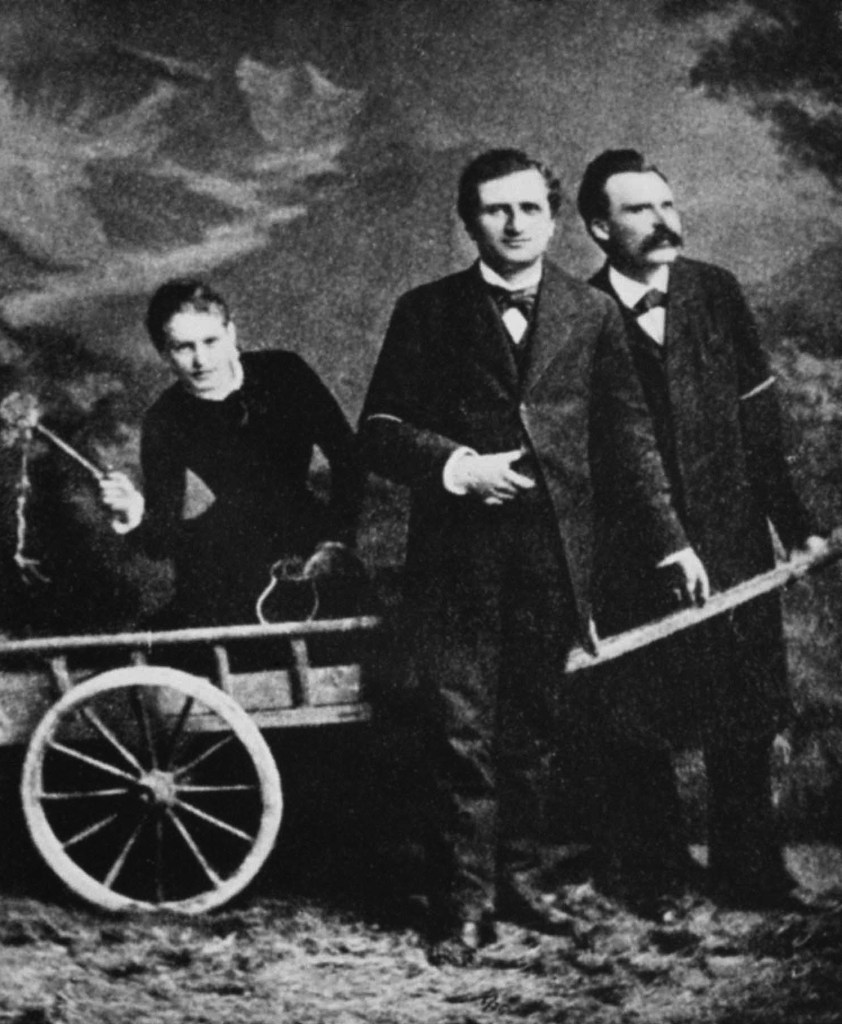
    Photo: P. Ree and F. Nietzsche submit to be draft animals in the service of Lou Salome

    Men who need women for masculinity validation are doomed to a life of emotional slavery and personality degradation.

    How do you know if you are such a man? Here’s how. If a woman makes you feel a heightened sense of self-esteem, self-confidence, ambition and drive that is lacking otherwise; if you feel that you could not live without her; if you would do anything for her although she often treats you badly; if she makes you feel like a man some of the time and a shit the rest of the time; if you have fallen helplessly in love with her … then you are such a needful man and you are likely doomed without knowing it!  Some guys find out the hard way.

    Sherrone Moore, the Michigan State football coach who just got fired for having an “inappropriate” relationship with a female underling is a perfect example of a man doomed by his strongly felt need to have his masculinity validated by a woman.  He was emotionally addicted to the young woman with whom he was having an affair.  He had given himself up to her power over him.  His relinquishment of his power to her was his downfall.  He was smitten unto derangement, totally hooked on her! You can always tell how desperately hooked on a woman a man is after he gets dumped by her.  True to form, Moore hit that wall and then made the very bad worse and worse. 

    His emotional enslavement to his assistant coach, his abject need for the validation of his masculinity from her, became disgustingly clear after he got fired when he threatened to kill himself as a way of punishing her for ratting to the university, saying it would be her fault that he did it. Oh, excuse me while I gag.  

    Suicide as a way of punishing others is the simpering passive aggressive threat of a lost soul, a doomed soul, the floundering of a powerless cuck.  On the other side, her complaint to the university, knowing that it would totally ruin the man’s life while saving her ass, shows the depth of her uncaring vitriol—as the house of cards they built together came crashing down on him.

    How is it that men become helplessly, emotionally and ontologically dependent on women for ‘masculinity validation’?

    Some might say that Sherrone shouldn’t have gotten romantically involved with her in the first place since she was his assistant, his subordinate.  But that is a naïve viewpoint and a fruitless argument.  The idea that there are not going to be love affairs between bosses and subordinates is unrealistic. It happens. Always has, always will.  C’mon, Sherrone’s girlfriend there is a grown woman who wants to be equal.  Okay then, man-up, woman!  Making it seem like he took advantage of her is pure bullshit.  It’s the proverbial pot calling the kettle black.  When are women going to start taking responsibility for their actions?

    If you look closely (i.e., truthfully), in fact, you will see how she made it happen.  She decided to seduce her boss, thus making the extramarital relationship possible.  The instigation, the solicitation of the woman is essential. He could not have had an affair with her without her wanting it and without her making it happen. 

    He was a wedlock-fatigued, emotionally needy black coach with a wife and three kids.  She was a cute young blond.  When she batted her eyelashes at him, he didn’t stand a chance because he was needy and vulnerable.  I don’t know what his married life was like, but the fact that he was having the affair at all suggests that his marriage was not satisfying his need for masculinity validation.  So, he went looking elsewhere.

    Most men are putty in the hands of a seductive woman intent on scoring with them.  Monica Lewinsky seduced Bill Clinton.  They make it sound like he was taking unfair advantage of her, but it was actually her that made it happen.  Bill fell (tumbled, crumpled) under Monica’s seductive spell.  She was always the one in charge because Bill was always the one in need.  You would be too if you were married to Hillary. 

    Men don’t have the power to make a sexual relationship happen with a woman on their command.  It helps to be in a position of power, of course.  But even then, the woman is in charge.  The woman has the power to make it happen or not.  And she can always yell “Rape!”—her special anti-male weapon.  The man can do whatever he wants but the decision to have sex will always be up to the woman. The woman is always truly responsible for spreading her legs, but the man, helpless though he is, is always blamed for causing the deed to be done.  Because women are not held accountable for the use and abuse of their earthy, seductive power, they are dangerous for men, toxic.

    Think about poor John the Baptist there in the Bible.  It is the sexy young Salome who brings Herod, the king, under her spell at his birthday party, and drives him into a lust-nut craze.  She dances seductively in front of him, and he is smitten, doomed. He gives her power over himself.  He is so enchanted with her that he blurts out that he will give her anything she wants, half his kingdom.  He will execute an innocent man for her, if she wants.

    Now there is a man who is totally under the sexual power of the woman—a lost soul, doomed, strangled by his unbridled infatuation.  But it is the sexpot and her vicious, serpentine mother, Herodias, who are responsible for the beheading of John the Baptist.

    Even the great sovereign individualist Nietzsche came under the disastrous spell of a young temptress, another Salome, Lou Salome.  Lou was a sexy, rich and well-educated seductive enchantress.  Friedrich really bit the dust on this one.  He goes all out for her, head over heels, proposes marriage numerous times and finally is devastated by her ultimate rejection of him.  Instead, and to make Nietzsche’s emasculation complete, she moves in with his best friend, Paul Ree.  It was like a knee to the crotch. The final blow.

    Salome was the great philosopher’s undoing.  Maybe it is what drove him mad and ultimately killed him.  For all his talk of the Sovereign Individual, he renounced his sovereignty willingly and readily for this globe-trotting, narcissistic Daddy’s girl (see photo above).  How desperately he wanted validation from her!  Lou was always in charge despite all of Nietzsche’s chest-thumping when he was with her.  She wound him up and then casually tossed him away.  But how emotionally vulnerable Nietzsche was!  The great man who had been raised by a series of women was completely vulnerable to the womanly wiles of Salome.  He never recovered from it.  “Going to see a woman?” he would say. “Don’t forget to take your whip!” from Thus Spoke Zarathustra

    One final, personal note. Men who need women for masculinity validation were consistently the kinds of men who ended up in my anger management classes after being arrested for domestic abuse.  For them, deluded as such men are, their anger and violence is always her fault. 

    What they don’t see, what they would come to see in my class, is that they give up their power to the woman because she is like a drug that makes them feel good and then they feel the need to control the power they have given away, and then they get angry when they can’t control her and feel insecure because of the power she wields over them to make them feel good (or bad).  Then the need to control escalates to physical attempts to control her and they end up in my anger management class working to get detached from their need for a woman to validate their masculinity.

    Last word.  It wasn’t that long ago that what we call domestic abuse today was required of the master of the house.  What happened to that sound thinking?  Here’s what happened. The women rebelled and all the pro-feminist men bowed down and castrated themselves, paving the way for the feminist assault on Western culture and beyond. Woe is us!

    It’s about time men started going their own way (MGTOW).

    Remember: If nobody is calling you a misogynist, you are surely not speaking honestly about women in general, and feminists in particular.